Employers often discover MSD cost late — when absence spikes, panel physio utilisation rises, or quality slips because people are working through pain. The better play is early access, ergonomics, and graded movement and strength — the bundle that workplace physiotherapy programmes are designed to deliver.
What the data actually confirms
Malaysia and global signals
- World Health Organization — low back pain is the single leading cause of disability globally in burden-of-disease analyses; that does not automatically make it “#1 sick leave line” in every employer’s HRIS, but it explains why back pain is a dominant chronic productivity problem.
- Malaysian labour and health statistics — official series on morbidity, injury, and leave patterns continue to show substantial chronic disease and MSD contribution to workforce health demand (exact rankings vary by publication year and classification).
- SOCSO and occupational injury discourse — musculoskeletal complaints, repetitive strain, and workplace ergonomics feature regularly in employer obligations and return-to-work conversations.
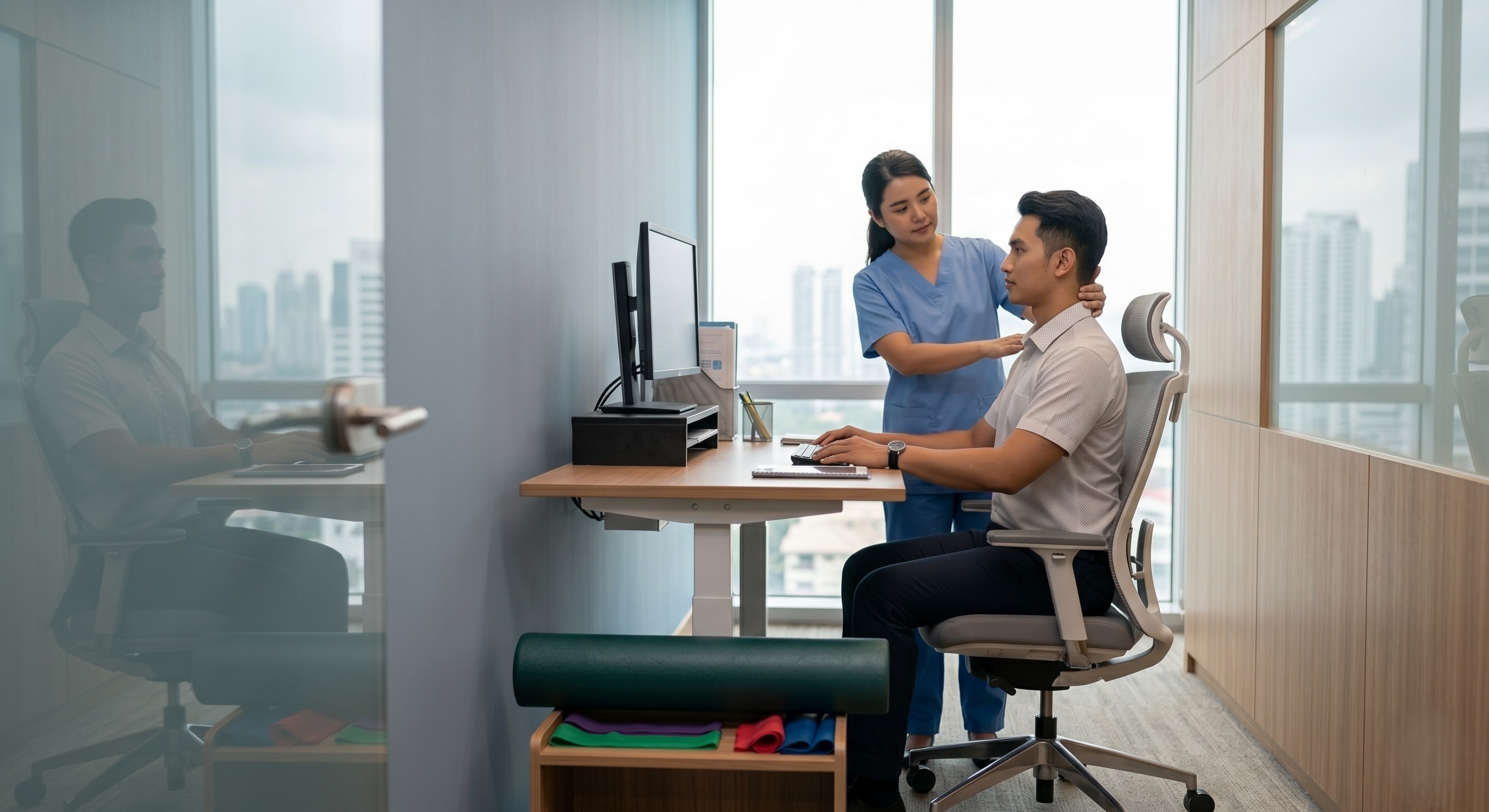
Why back pain dominates office absenteeism
Root causes in modern work
- Prolonged sitting — often 8–10 hours with few meaningful movement breaks.
- Poor ergonomics — monitor height, chair depth, keyboard reach, laptop-only setups without peripherals.
- Low physical activity outside work and deconditioned trunk muscles.
- Psychosocial load — stress and sleep loss lower pain tolerance and slow recovery.
Typical pathway: episodic strain → repeated micro-trauma → persistent pain and guarded movement → more sick days and more “present but impaired” days.
Business impact (often underestimated)
| Cost type | How it shows up |
|---|---|
| Absenteeism | Short certifiable episodes (often a few days) that repeat across the year |
| Presenteeism | Reduced focus, slower throughput, more errors — frequently larger in aggregate than recorded sick days |
| Medical claims | GP visits, analgesics, imaging in selected cases, panel physiotherapy |
| Longer incapacity | Severe or complicated cases with longer protected leave or job modification |
For how to model benefit versus programme spend at employer level, see our corporate wellness ROI framework.
Why physiotherapy works (evidence-based)
Clinical guidelines in high-income health systems generally recommend staying active, structured exercise, and manual therapy or supervised rehab for non-specific low back pain in primary care pathways — rather than passive treatment alone. The UK’s National Health Service (NHS) patient guidance emphasises movement, self-management, and timely professional support when pain persists or red flags appear.
The WHO frames physical activity and rehabilitation as central to healthy ageing and to reducing disability from MSK conditions — consistent with workplace programmes that teach graded loading, not only short-term symptom relief.
Physiotherapy in structured workplace programmes
Well-run corporate ergonomics and physio tracks often report, over roughly 4–8 weeks for motivated cohorts:
- Lower pain scores and improved function scores on standardised tools.
- Fewer MSD-related sick days versus the prior season (especially when combined with workstation fixes).
- Better reach and compliance when sessions are on-site or near-site with scheduled slots.
In aggregated employer reporting, roughly 20–40% reduction in MSD-related absence can be a planning bracket when baseline absence is high and participation is strong — validate on your own data before external marketing claims. Marketing figures such as “up to 60% fewer complaints” should be treated as vendor-specific or trial-specific unless you hold the underlying study.
Why companies fail to solve it
- Insurance-only mindset — paying for treatment after pain is chronic, without changing the workstation or work pacing.
- No ergonomic correction — the same biomechanical insult repeats daily.
- Delayed access — long waits before first meaningful rehab session.
- No education — employees do not know safe loading, pacing, or when to escalate.
What effective employers do
An integrated pattern that matches international good practice and Malaysian delivery realities:
- 1. Ergonomic assessment — desk, chair, screen, task rotation; prioritise high-risk teams first.
- 2. Early, convenient physiotherapy — on-site blocks or pharmacy-clinic adjacency so the “friction cost” of attending is low.
- 3. Exercise and strength — short, repeatable mobility and trunk endurance routines employees can sustain.
- 4. Behaviour change — micro-breaks, standing meetings where appropriate, and manager norms that do not reward presenteeism.
First-principles insight
Malaysia-specific relevance
- Large office + retail + operations mix — both prolonged sitting and prolonged standing occur at scale.
- Limited ergonomic literacy in fast-growing SMEs; “bring your own device” laptop culture worsens neck and upper-back load.
- For integrated operators such as Alpro, pharmacy and frontline roles add standing and lifting exposure, while HQ teams add sitting load — both benefit from the same programme discipline with different risk assessments.
Bottom line
- Back pain and MSDs are among the top drivers of office-related absence and productivity loss in Malaysia — even when not literally “#1” in every dataset.
- The largest employer cost is often presenteeism and recurrence, not a single GP bill.
- Evidence-aligned workplace physiotherapy, paired with ergonomics and behaviour change, is a high-leverage intervention when deployed with measurement and access in mind.
See Ergonomic Physio for programme design, or contact Alpro Health to scope on-site delivery.
Sources & further reading
Guidelines evolve; confirm clinical pathways with your occupational health provider.
- WHO — Low back pain (fact sheet)
- WHO — Physical activity (fact sheet)
- NHS (UK) — Back pain — overview and self-care
- Alpro Health — Ergonomic Physio programme
End of article